
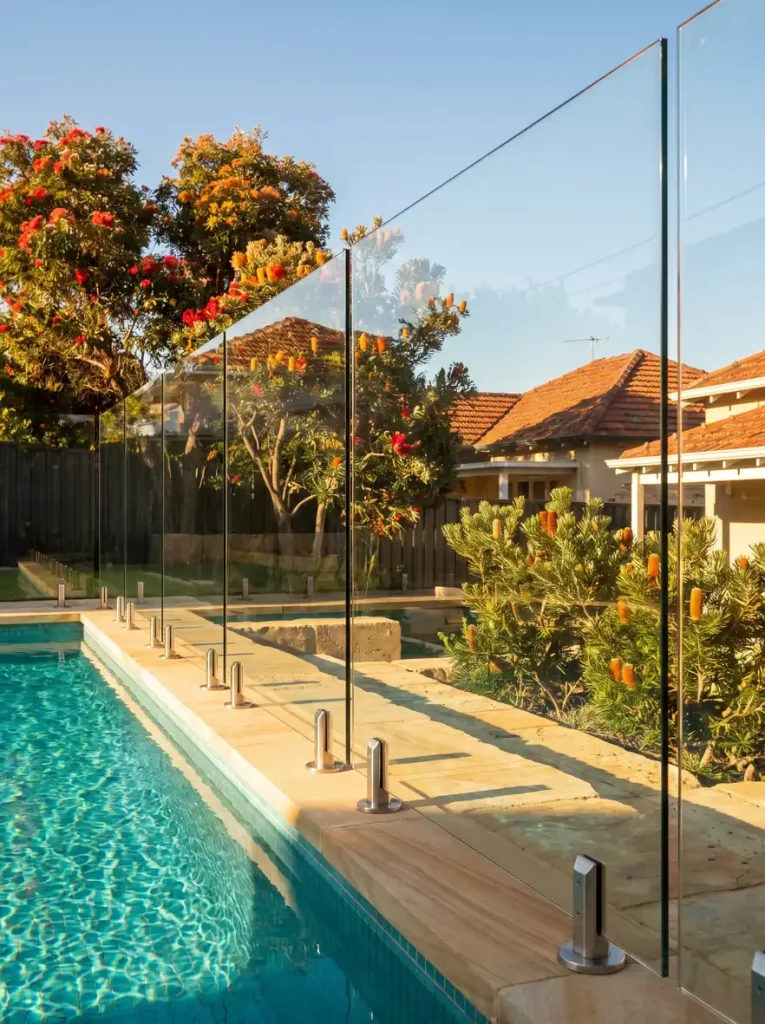
Most pool owners know the law requires a barrier around their pool. Far fewer understand the precise construction standards that govern every measurement, gap and gate mechanism behind that requirement. Choosing a compliant pool fence for your Perth home starts with understanding the build code that defines each barrier dimension, because a fence can look secure and still fail an assessment by a few millimetres. This article works through those technical specifications in plain terms.
Prefer to watch or listen?
Listen onApple Podcasts
What the Building Code and AS 1926.1 Actually Specify
In Western Australia, pool barriers are governed by the Building Code of Australia together with the relevant Australian Standard, AS 1926.1, which deals with the design and construction of pool safety barriers. The standard sets out the physical rules a barrier must meet to restrict young children from reaching the water unsupervised.
These documents do not describe the fence in vague terms. They specify exact heights, maximum gaps, climbable object placement and gate behaviour. Every requirement exists to remove a path a small child might use to climb over, squeeze through or open the barrier. Builders and inspectors measure against these numbers directly.
Minimum Barrier Height and Ground Clearance
The standard requires a pool barrier to reach a minimum effective height measured from the finished ground level on the outside of the fence. The widely applied figure is 1200mm. The measurement is taken from the surface a child could stand on, not from the base of a footing buried below ground.
Ground clearance matters just as much. The gap between the bottom of the barrier and the ground must stay within a strict maximum, typically no more than 100mm. This prevents a child from sliding underneath. On uneven Perth blocks, where ground levels often slope or shift over time, this clearance needs checking along the entire run of the fence, not just at one point.
Gap Rules: Vertical, Horizontal and Below the Fence
Gaps are one of the most common reasons a barrier fails. Vertical gaps between balusters or panels must not exceed 100mm, so a child cannot push their body through. This applies whether the fence is tubular aluminium, glass or another material.
Horizontal gaps are treated differently because horizontal elements can act as footholds. Where the standard permits horizontal rails, their spacing is controlled to avoid creating a climbable ladder effect. The gap below the fence follows the same 100mm limit as ground clearance. Together, these gap rules close off the three obvious paths under, through and over a barrier.
Non-Climbable Zones and the 900mm Rule
A non-climbable zone is an area around the barrier kept clear of anything a child could use as a foothold. The standard defines a zone measured as an arc, commonly described in terms of the 900mm rule, where no climbable object may sit within reach of the top of the fence.
This shapes where a barrier can go. Horizontal rails, retaining walls, garden beds, pot plants, air conditioning units and pool pumps all become relevant. If a climbable feature sits inside the non-climbable zone, the barrier fails even if its height and gaps are perfect. This is why fence positioning is a design decision, not just a fencing-line decision. Around many Perth backyards, limestone retaining walls and built-in planters frequently sit close to the boundary and need careful assessment.
Gate Construction Requirements
Gates carry some of the strictest rules because they are the moving part of the barrier. A compliant pool gate must be self-closing from any open position and self-latching once it swings shut. It cannot rely on a person remembering to push it closed.
The gate must open outward, away from the pool area, so a child leaning on it cannot force it inward. The latch release must sit at a minimum height, generally 1500mm above ground level, or be shielded so a small child cannot reach through and operate it. Hinges and latches all fall within the same height, gap and non-climbable rules that apply to the rest of the barrier.
How Perth Materials and Site Conditions Interact with the Code
The same code applies regardless of material, but local conditions affect how it is met during construction. Sandy soils common across the Perth metro area can shift, altering ground clearance over time. Limestone, sloping blocks and reactive ground all influence footing depth and the finished height of the barrier.
Coastal exposure also matters for hardware. Self-closing hinges and self-latching mechanisms must keep working reliably in salty, windy conditions, so material choice affects ongoing compliance, not just the day of installation. Because conditions change, it helps to understand how regularly a Perth pool fence should be checked against these standards once it is in place.
Getting these technical details right protects children and keeps your barrier on the right side of the rules. In the next article, we look at what happens when a barrier does not meet them: the penalties for non-compliant pool fencing in Perth.