
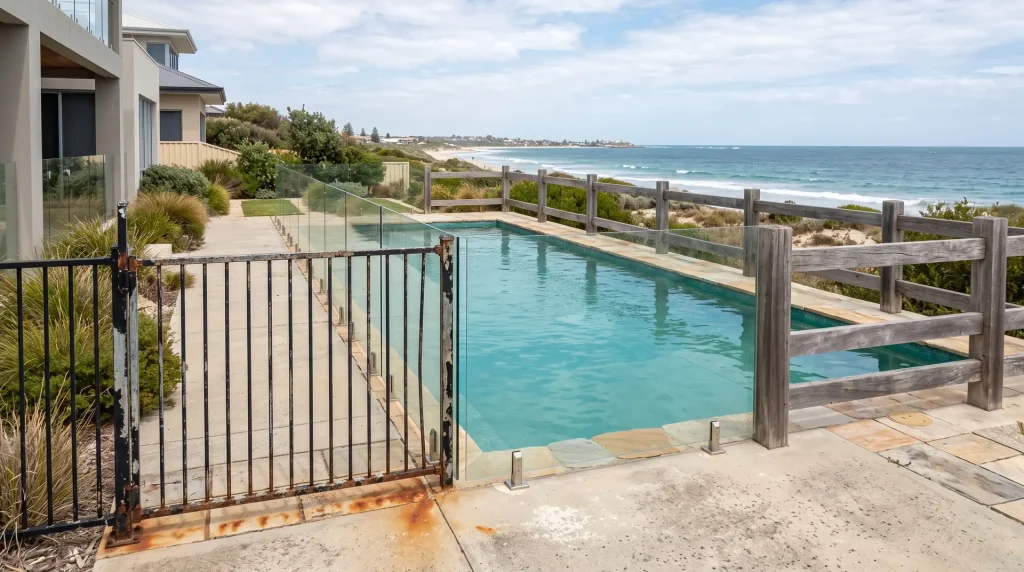
Anyone who lives within a few kilometres of the Perth coast knows the feeling: a fine, invisible film that settles on cars, windows and outdoor railings, gritty to the touch after a week without rain. That film is salt, carried inland on the sea breeze, and it never really stops arriving. Choosing the right pool fencing for these conditions is often the difference between a barrier that stays safe and attractive for years and one that begins to degrade far earlier than it should.
Salt corrosion is the single biggest environmental threat facing pool fences in coastal suburbs. Understanding how it works helps you make a smarter choice between materials and gives you the knowledge to spot trouble before it undermines your fence.
Prefer to watch or listen?
Listen onApple Podcasts
How Coastal Salt Air Reaches Your Pool Fence
Salt does not need a storm to travel. When waves break along Perth’s beaches, they throw tiny droplets of seawater into the air. The water evaporates, but the salt remains as microscopic particles that the prevailing sea breeze carries inland.
Suburbs closest to the coast — places like Scarborough, Cottesloe, Hillarys and Fremantle — receive the heaviest, most constant salt load. As you move further from the water, the concentration drops, but it does not vanish. On breezy afternoons, salt can settle on fences several kilometres from the shore.
Once those particles land on your pool fence, they cling to horizontal surfaces, gather in corners and work their way into the small gaps around fixings and hinges. Without rain to wash them away, they build up steadily over time.
The Corrosion Process Explained
Metal corrodes when it reacts with oxygen and moisture. Salt speeds this reaction up dramatically. Salt is hygroscopic, meaning it draws moisture out of the air, so a salted surface stays damp for longer even on a dry Perth day. That prolonged dampness gives corrosion more time to take hold.
Salt also acts as an electrolyte, carrying an electrical charge that accelerates the exchange of electrons between metal and its environment. This is why untreated or poorly protected metal near the coast can pit, stain and weaken far faster than the same metal inland.
The real danger is that salt attacks the protective barriers first. Once a coating is breached, moisture and salt reach the raw metal underneath and corrosion spreads outward from that single point.
Powder-Coated Aluminium Versus Glass Fencing
Different fencing materials respond to salt in very different ways.
- Powder-coated aluminium: Aluminium itself resists corrosion well because it forms a natural protective oxide layer. The powder coating adds another barrier. The vulnerability lies in any point where that coating is chipped, scratched or thin — and in the fixings, brackets and posts that hold everything together.
- Glass fencing: The glass panels are effectively immune to salt corrosion. However, glass fencing still relies on metal hardware — spigots, clamps, hinges and latches — and these components carry the full weight of coastal exposure.
In both systems, the weakest links are almost always the metal fittings. Hinges, latches, screws and mounting posts have small crevices where salt settles and moisture lingers. When these fail, the fence can loosen, sag or stop latching correctly, which becomes a genuine safety concern.
Why Material and Installation Quality Matter
A fence is only as durable as its most exposed component. Even the highest-grade aluminium or toughest glass panel will disappoint if it sits on hardware that cannot handle salt.
Material selection matters, but so does how the fence is put together. Fixings rated for marine or coastal environments resist salt attack far better than standard fittings. Careful installation — avoiding scratches to coatings, sealing exposed points and choosing quality stainless components — has a direct effect on how long a fence survives near the ocean.
For coastal Perth homes, treating hardware as a priority rather than an afterthought is one of the most important decisions you can make.
Early Warning Signs of Salt Damage
Salt corrosion rarely announces itself all at once. It creeps in, so catching it early saves both money and hassle. Watch for:
- Small rust spots or brown staining around screws, brackets and hinges
- White, powdery or chalky residue on metal surfaces
- Bubbling, flaking or lifting powder coating on aluminium
- Pitting or roughness where the surface once felt smooth
- Hinges or latches that grind, stiffen or no longer close cleanly
- Loosening at posts or mounting points where fittings meet concrete
Any of these signs at the mounting points or gate hardware deserves prompt attention, because these are the parts that keep the barrier secure.
Maintenance Habits That Reduce Salt Build-Up
The best defence against salt is simply not letting it accumulate. A regular rinse with fresh water removes the film before it can do lasting harm. Pay particular attention to hinges, latches, spigots and any recess where salt collects out of the rain.
Drying and lubricating moving hardware after rinsing keeps latches operating smoothly. Inspecting fixings periodically lets you replace a corroded screw or bracket long before it compromises the whole panel. These small, consistent habits extend the life of a coastal fence considerably.
Salt air, though, is only one of the pressures a Perth pool fence must withstand. The very same fences that battle the sea breeze also stand exposed to relentless summer sun and extreme heat, which strain materials in an entirely different way. Understanding how prolonged sun exposure and high temperatures affect your fence rounds out the full picture of what coastal living demands from a pool barrier.