
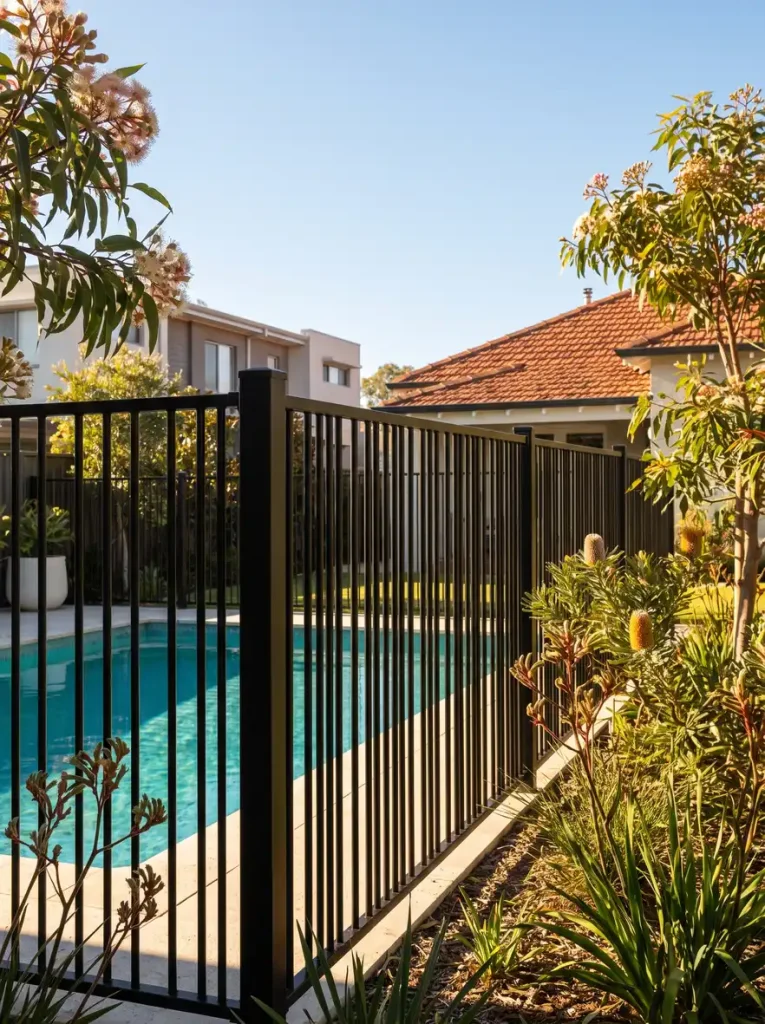
Drowning is one of the leading causes of accidental death in young children across Australia, and Western Australia takes pool safety seriously as a result. If you own a swimming pool or spa in Perth, the law places clear obligations on you to install and maintain a compliant barrier — and the rules are more detailed than many people realise. This article walks through everything you need to understand about pool fencing compliance in WA, from which pools are covered to what the physical barriers must actually look like.
01 — Which Pools Are Covered by WA Law
The Building Act 2011 and the associated Building Regulations 2012 govern pool fencing requirements in Western Australia. Under these rules, any pool or spa that can hold water to a depth of 300mm or more must be enclosed by a compliant barrier. This includes in-ground pools, above-ground pools, portable pools, and spa pools — if the water depth can reach that threshold, the requirement applies.
Many Perth residents assume a small above-ground pool or a portable inflatable doesn’t need a fence. In most cases, that assumption is incorrect. If the pool holds enough water to reach 300mm in depth, it falls under the legislation regardless of how permanent or temporary it is. The test is about water depth potential, not the physical size or style of the pool.
Local governments (councils) in the Perth metropolitan area administer and enforce these rules. While the state legislation sets the framework, your local council is the body responsible for inspections, compliance notices, and approvals. It’s worth knowing which council your property falls under, as contact details and processes can vary slightly.
02 — The Barrier Requirements: What the Fence Must Do
WA pool fencing law doesn’t just require that a fence exists — it sets out specific performance requirements for what that barrier must achieve. The central principle is that the pool area must be enclosed in a way that prevents young children from accessing the water without an adult’s assistance or knowledge. This is why the rules focus heavily on climbability, height, and gate behaviour.
The minimum height for a pool barrier in WA is 1200mm, measured from the finished ground level on the outside of the fence. There must be a non-climbable zone (NCZ) on the outside of the fence — a 900mm clear space free from anything a child could use to climb over. This means garden beds, outdoor furniture, retaining walls, and even certain plants cannot be positioned close to the outside of the fence in a way that reduces its effective height.
Gates must be self-closing and self-latching, and the latch must be positioned so that it cannot be reached by a young child. Specifically, if the latch is on the inside of the gate, it must be at least 1500mm above the ground, or it must be located in a position that prevents a child from reaching through or around the gate to operate it. Gates must also open outward — away from the pool — so that a child pushing against the gate cannot inadvertently open it.
03 — How the Rules Apply to Your House
In Western Australia, pool barriers are required to isolate the pool from the house and from the rest of the property. This is known as full perimeter fencing. The entire pool area must be enclosed, and the fence must separate the pool from any building on the property.
This means you generally cannot use the wall of your house as part of the pool barrier unless that wall meets specific requirements under the Building Code of Australia — including ensuring that any doors opening from the house directly into the pool area are compliant and fitted with self-closing, self-latching mechanisms. These doors must meet the same standards as pool gates. Many Perth homeowners are caught out on this point, assuming a sliding door to a patio area doesn’t need to meet pool gate standards when it does if it opens into the pool enclosure.
If your property has been subdivided, extended, or had its landscaping changed, it’s worth reviewing whether the existing pool barrier still meets requirements. Changes to the surrounding environment — including new garden beds, decking, or structures — can inadvertently create a climbable hazard that puts you out of compliance even if the fence itself hasn’t changed.
04 — Older Pools and Transitional Provisions
Western Australia has updated its pool fencing standards over the years, and pools built under older rules have at various points been granted transitional periods to comply. As of now, the transitional provisions that previously allowed some older pools to operate under different standards have largely expired. Most pools in WA — regardless of when they were built — are now expected to comply with the current standards under the Building Regulations 2012.
If you’ve purchased a property in Perth with an existing pool, you should not assume that the barrier is compliant simply because the pool has been there for many years. An older fence may have been legal under previous rules but fail to meet current requirements. It’s your responsibility as the current property owner to ensure the barrier is up to standard now, not just when it was originally installed.
05 — Registration and Inspection Obligations
All pools and spas in Western Australia that are required to have a barrier must also be registered with the relevant local government. Registration is the mechanism by which councils identify pools in their area and schedule inspections. If you have a pool that isn’t registered, you’re likely in breach of your obligations before an inspector has even looked at your fence.
Inspections are conducted by local government inspectors and are a normal part of owning a pool in WA. Councils are required to inspect pools on a regular cycle, and you may also be subject to a re-inspection if your pool has previously been found non-compliant. If an inspector identifies issues, you’ll typically be given a notice requiring you to fix the problem within a specified timeframe. Failing to do so can lead to further enforcement action and penalties.
Being proactive about registration and keeping your barrier in good condition is far simpler than dealing with a compliance notice after an inspection. Councils have the authority to issue significant fines for non-compliance, and in serious cases, they can require a pool to be drained or decommissioned until the barrier meets the required standard.
Making Sense of What You Need
Pool fencing law in Western Australia is detailed, but the underlying logic is consistent: create a barrier that a young child cannot get through, over, or around without help. If you understand that principle, most of the specific requirements — height, non-climbable zones, self-latching gates, door compliance — start to make sense as practical expressions of that goal rather than arbitrary rules.
The most important steps for any Perth pool owner are to confirm your pool is registered with your local council, check that your barrier meets the current physical requirements (including gates and any house walls that form part of the enclosure), and stay on top of maintenance so that the fence remains compliant over time. Changes to your garden, outdoor furniture, or landscaping can affect compliance even if you haven’t touched the fence itself.
There’s more to staying on top of your legal obligations than understanding what the fence must look like. Knowing how frequently your barrier needs to be checked by an inspector — and what triggers an inspection — is just as important, and we’ll be covering how often Perth pool fences need to be inspected in an upcoming guide in this series.