
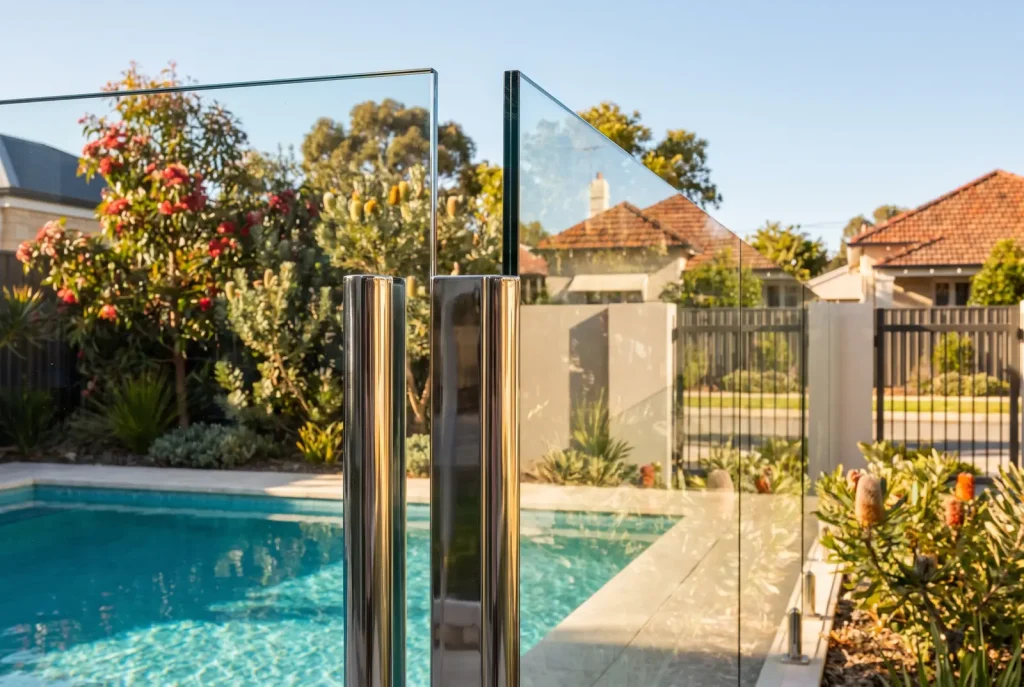
You have hosed down the panels, wiped them over, and stood back to admire the job. Yet in the afternoon light the glass still shows cloudy white spots, a chalky film, and patches that look almost frosted. No amount of scrubbing seems to lift them. That is because these marks are not grime at all. They are mineral deposits left behind by hard water, and they behave very differently from ordinary dirt. Owners of glass pool fencing in Perth see this often, because local water hardness, constant splash-back from the pool and intense sun all work together to bake these deposits onto the surface.
This article stays narrowly focused on that one stubborn problem: bonded mineral scale that normal washing cannot shift. If you want the broader routine, our guide on cleaning glass pool fencing without streaks or damage covers everyday technique. Here we tackle the calcium and hard water stains that resist it.
What Hard Water Stains and Calcium Build-Up Actually Are
Hard water carries dissolved minerals, mainly calcium and magnesium. When water lands on a glass panel and evaporates, the water disappears but the minerals stay behind. Over time these deposits layer up and harden into a crust that bonds tightly to the surface.
On glass, this shows up as white spots, milky streaks or a rough chalky film. Pool water adds to the problem, because it is treated with salts and chemicals that leave their own residue when splashed onto the fence and left to dry. Each cycle of wetting and drying adds another thin layer, and the deposit gradually thickens until it looks permanent.
Why Perth Conditions Speed Up Mineral Deposits
Several local factors combine to make this worse around Perth pools:
- Water hardness: Both scheme water and bore water in many parts of the metro area carry a high mineral load, so every splash leaves more behind.
- Constant splash-back: Pool water repeatedly hits the lower panels, and salt-chlorinated pools deposit salt as well as calcium.
- Strong UV and heat: Intense sun evaporates water quickly and effectively bakes the minerals onto the glass before you get a chance to rinse them off.
- Long dry spells: With little rain to wash panels naturally, deposits accumulate undisturbed for weeks at a time.
The result is a build-up that forms faster and harder than it would in cooler, softer-water regions.
How to Tell Mineral Scale Apart From Everyday Dirt
Correctly identifying the problem matters, because the fix is different. A few simple checks help:
- Ordinary dirt and dust wipes away easily with water and a soft cloth and leaves the glass clear underneath.
- Streaking tends to appear after cleaning, is faint, and comes from drying marks rather than a raised texture.
- Salt residue feels slightly gritty and often dissolves with a plain water rinse.
- Mineral scale stays put after washing, feels rough or chalky to the touch, and looks like cloudy white spots or a frosted film that does not budge.
If the glass still looks hazy after a thorough wash and dry, you are almost certainly dealing with bonded mineral deposits.
Safe Methods to Soften and Remove Calcium Stains
The key with mineral scale is to dissolve it gently rather than grind it off. Follow a slow, patient sequence:
- Rinse the panel first with clean water to remove loose grit that could scratch during cleaning.
- Apply a mild acidic solution suited to glass, such as diluted white vinegar, to the affected area and let it sit so it can soften the deposit. Do not let it dry on the surface.
- Give the solution time to work. Bonded scale needs dwell time far more than it needs force.
- Wipe gently with a soft, non-abrasive cloth or pad, using light pressure and letting the softened deposit lift away.
- Rinse thoroughly with clean water so no acidic residue remains on the glass or the fittings.
- Dry the panel completely with a clean cloth or squeegee to stop fresh water marks forming.
Take particular care around the metal spigots, clamps and hinges. Acidic solutions can dull or corrode fittings if left in contact too long, so keep dwell time short there and rinse well.
Mistakes That Cause Permanent Etching or Scratching
Most of the lasting damage seen on glass fences comes from impatience rather than the stains themselves. Avoid these common errors:
- Using abrasive pads, steel wool or scouring powders, which leave fine scratches you cannot polish out.
- Applying strong or undiluted acids, which can etch the surface and permanently cloud the glass.
- Letting any solution dry on the panel in the sun, which concentrates it and creates fresh marks.
- Scrubbing hard over dry grit, dragging particles across the glass like sandpaper.
- Ignoring the fittings, allowing acidic runoff to pit or discolour brackets and hinges.
Etching is not a stain sitting on top of the glass. It is damage to the glass itself, and it does not clean off.
Simple Habits to Slow Down Build-Up
You cannot change Perth’s water, but you can reduce how quickly deposits form. Rinse the lower panels with fresh water after heavy pool use to wash off splash before it dries. Dry panels rather than letting them air-dry in the sun where possible. Manage splash from features, cleaning equipment and swimmers so less pool water lands on the glass. A quick rinse and wipe done regularly prevents the thick, bonded scale that is so hard to remove later.
Removing stubborn calcium safely comes down to one thing above all: choosing the right cleaning agent and the right applicator for glass and its fittings. Nearly every case of etching or scratching traces back to the wrong product or the wrong tool. Getting familiar with which glass-safe cleaning products and tools actually suit these panels is the single best way to protect your fence while you clear the marks.