
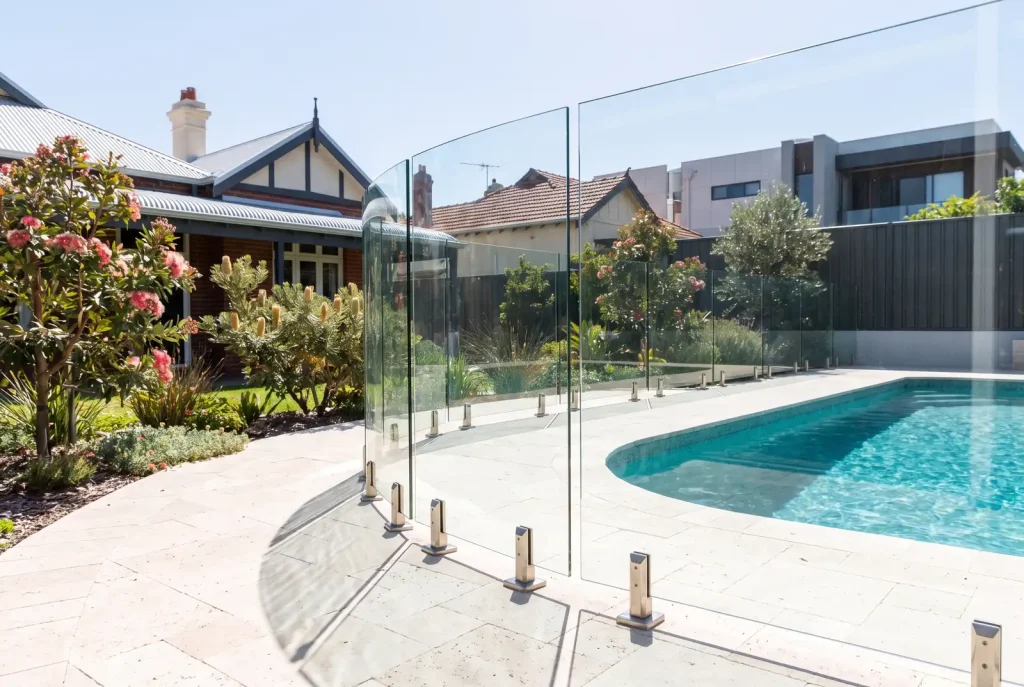
Stand next to two glass pool fences and most people struggle to tell them apart. The clear panels and open feel look almost identical from a distance, yet the way each system is engineered and installed differs in ways that affect appearance, cost and long-term performance. When homeowners start researching glass pool fencing, they quickly discover that frameless and semi-frameless are the two main approaches within this category, and choosing between them is one of the first real decisions to make.
Understanding what separates the two systems helps you match the right one to your backyard, your pool surround and Perth’s demanding coastal climate.
Prefer to watch or listen?
Listen onApple Podcasts
What Defines Frameless Glass Pool Fencing
Frameless glass fencing uses individual toughened glass panels held in place with minimal hardware. There are no posts between the panels. Instead, the glass is supported from below by small metal fittings called spigots, or fixed to an adjacent wall using standoff fittings.
This creates a fence that appears almost invisible from a few metres away. The only visible hardware sits at the base of each panel, so the eye reads a continuous sheet of glass rather than a series of framed sections. For homeowners chasing an uninterrupted view of the pool and landscaping, frameless delivers the cleanest result.
Because each panel relies on secure base fixings to stay upright and stable, the mounting surface and installation precision carry a lot of weight in this system.
What Defines Semi-Frameless Glass Pool Fencing
Semi-frameless fencing also uses toughened glass panels, but each panel sits between vertical posts. These posts are usually slim metal profiles fixed to the ground or a surrounding surface, and they carry much of the structural load.
The posts are visible, so the fence does not achieve the same seamless look as frameless. In return, the panels are supported on their edges rather than relying solely on base fittings. Many Perth homeowners find this a practical middle ground, offering a clear view of the pool while using a system that is often simpler to install and align.
The visible posts become part of the design rather than something to hide, which some owners actually prefer for a more defined boundary.
Visual and Design Differences
The biggest everyday difference is sightlines. Frameless fencing gives the most open, borderless feel and suits backyards where the pool is a visual centrepiece or where you want an infinity-style connection to a garden, patio or view beyond.
Semi-frameless breaks the view slightly with its posts, but the effect is still far more open than traditional metal or timber fencing. In practice:
- Frameless suits large, open pool surrounds where uninterrupted sightlines matter most.
- Semi-frameless works well on longer runs where visible posts add rhythm and structure.
- Both blend into modern Perth alfresco and coastal-style outdoor areas.
Your backyard layout, the shape of the pool and where people will view it from all influence which look feels right.
Practical and Site Considerations
Installation demands differ between the two systems, and Perth’s ground conditions play a role here. Many local blocks feature sandy soils, limestone and paved or concrete pool surrounds, and each surface handles fixings differently.
Frameless panels place more reliance on the strength of the base fixing, so the mounting surface needs to be sound and correctly prepared. Concrete and solid paving generally provide the stability these fittings need. On less predictable ground, extra preparation may be required to ensure the base fixings hold securely.
Semi-frameless systems spread support across posts and panels, which can make them more forgiving on certain surfaces. The posts give installers additional fixing points, which sometimes simplifies alignment on uneven or awkward runs.
Either way, correct fixing into a suitable surface is what keeps a glass fence safe and stable over the long term, so site assessment matters for both.
Durability and Maintenance in Perth’s Coastal Climate
Perth’s combination of salt-laden coastal air and intense UV exposure is tough on any outdoor fixture. Glass itself handles sun and salt well, but the metal hardware is where wear shows first.
Frameless fencing uses less hardware overall, with fittings concentrated at the base of each panel. Fewer components mean fewer points exposed to corrosion, though those base fittings still sit close to splash zones and need periodic checking and cleaning.
Semi-frameless fencing has more visible hardware in the posts. That extra metal gives more surface area for salt and grime to settle on, so near-coastal properties may notice these components need more regular attention. Quality fittings and routine rinsing help both systems age gracefully in a marine environment.
Cleaning the glass is straightforward for either option, and a simple maintenance routine keeps both looking clear season after season.
How to Decide Between the Two
The right choice comes down to your priorities. Ask yourself what matters most for your specific pool area:
- If an unbroken, minimalist view is the goal, frameless usually wins.
- If you want a clear outlook with a slightly simpler and often more budget-friendly install, semi-frameless is worth serious consideration.
- If your surround is uneven or awkwardly shaped, the post support of semi-frameless can be an advantage.
- If your pool is a design feature framed by open space, frameless enhances that effect.
There is no single better system. The best fit depends on how you use the space, how it looks and how the fence sits against your particular pool surround.
Once you have settled on frameless or semi-frameless, the next critical choice is the glass itself. Panel strength and thickness underpin the safety and longevity of either system, which is why understanding your toughened glass thickness options is the natural next step in getting your pool fence right.