
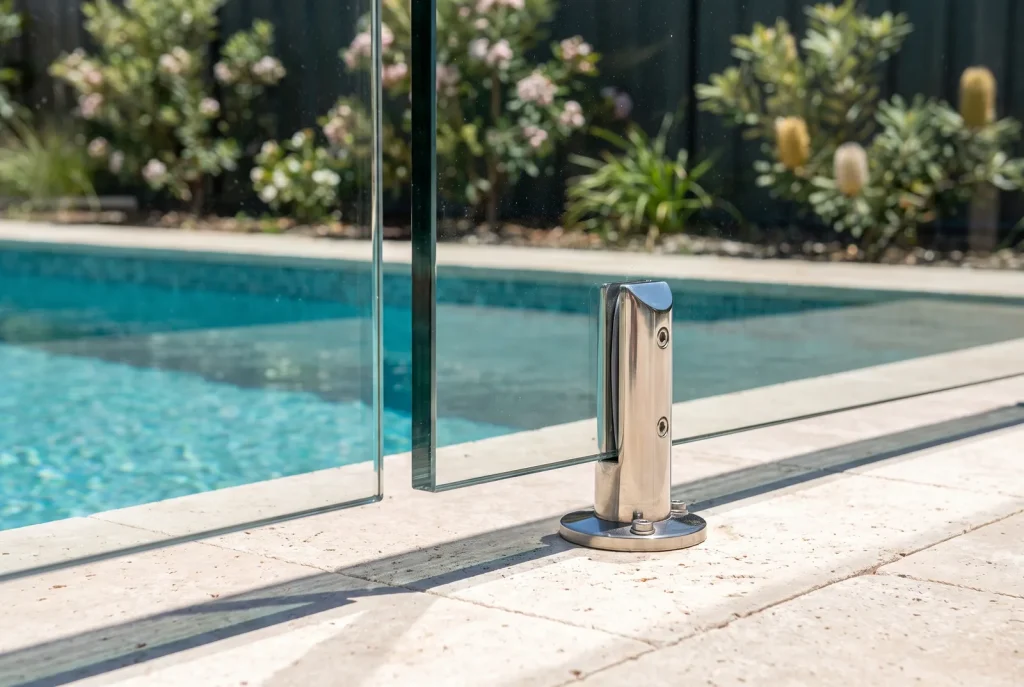
Once you’ve settled on the look of your glass fence, the next practical question tends to be a simple one: how thick should the glass actually be? It sounds like a minor detail, but thickness is a genuine structural and safety decision that affects how the fence performs and how it feels to stand beside. When planning glass pool fencing in Perth, panel thickness is one of the details worth understanding before installation begins, because it influences everything from panel height to how the glass holds up under wind.
Prefer to watch or listen?
Listen onApple Podcasts
What ‘Toughened’ Really Means for Pool Glass
Pool fencing glass is always toughened, never standard annealed glass. Toughening is a heat-treatment process that makes the glass several times stronger than ordinary glass of the same thickness. Just as importantly, it changes how the glass behaves if it ever does break.
Standard glass breaks into large, sharp shards. Toughened glass is designed to shatter into small, blunt fragments, which dramatically reduces the risk of serious injury near a pool. That safety behaviour is exactly why building rules require toughened glass for pool barriers, and why no reputable installer would ever use anything else.
10mm and 12mm Panels Compared
Both 10mm and 12mm glass are fully toughened, so the difference isn’t about whether one is “safety glass” and the other isn’t. Both are. The difference is structural.
- Strength and rigidity: 12mm glass is thicker and stiffer, so it flexes less under load and feels more solid.
- Weight: A 12mm panel is noticeably heavier than a 10mm panel of the same size, which affects handling during installation.
- Span and height capacity: The extra thickness lets 12mm panels span wider or stand taller between supports while staying rigid.
For many domestic pools, 10mm glass is perfectly adequate. But as panels get taller, wider or more exposed, the added stiffness of 12mm starts to matter.
How Thickness Interacts With Height, Span and Support
Thickness never works in isolation. A panel’s performance depends on how tall it is, how wide it is, and how it’s held in place. A short, narrow panel gripped firmly along its base can perform well in 10mm. A tall panel, or one carrying a gate, or one with a wide unsupported span, asks more of the glass.
The support method matters here too. Frameless panels held only at the base rely heavily on the glass itself for rigidity, so thickness and span have to be matched carefully. This is a different structural conversation from the framing-style debate covered in our comparison of frameless and semi-frameless glass fencing; here we’re focused purely on the glass spec, not the look of the frame.
Wind Loading and Coastal Exposure in Perth
Wind is a real structural factor for glass fencing, and it varies across the metro area. A pool tucked into a sheltered courtyard in the eastern suburbs faces very different conditions from one on an exposed coastal block catching afternoon sea breezes.
Glass panels act like sails. Wind pressure pushes against the full face of each panel and transfers that load down into the supports and the ground. Taller and wider panels catch more wind, which increases the demand on the glass and its fixings.
In more exposed or coastal Perth locations, thicker 12mm glass can be the sensible choice because it resists flex better under wind pressure. For sheltered inland sites with modest panel sizes, 10mm often does the job comfortably. The right answer depends on the specific site rather than a blanket rule.
Appearance, Clarity and Feel
Thickness also affects how the fence looks and feels. Thicker glass reads as more substantial when you view it edge-on, and that solid appearance is part of why some homeowners prefer 12mm around a feature pool.
Edge finishing becomes more prominent with thicker glass too, since the polished edge is simply larger and more visible. Across the flat face, both thicknesses offer excellent clarity, so the view through the panel is broadly similar. The main visual differences show up at the edges and when you run a hand along the top of the glass, where 12mm feels reassuringly firm and rigid.
Matching Thickness to Your Situation
There’s no single correct thickness for every pool. The best choice comes from weighing panel size, exposure and how the fence will be used.
- 10mm often suits: standard-height panels, sheltered or inland positions, and typical domestic runs where spans are moderate.
- 12mm often makes sense: taller panels, wider spans, coastal or wind-exposed blocks, gate panels, and situations where a heavier, more solid feel is wanted.
An experienced installer will look at your actual layout, the panel sizes involved and your site’s exposure before recommending a thickness, rather than defaulting to one option for every job.
Thickness, though, is only half the structural story. However rigid the glass is, it still needs something to hold it firmly at the base and transfer all that wind and weight load safely into the ground. The way each panel is gripped and supported plays just as big a role in stability and appearance, which is why it’s worth understanding the base-fixing options used to support frameless glass panels before you finalise your fence.