
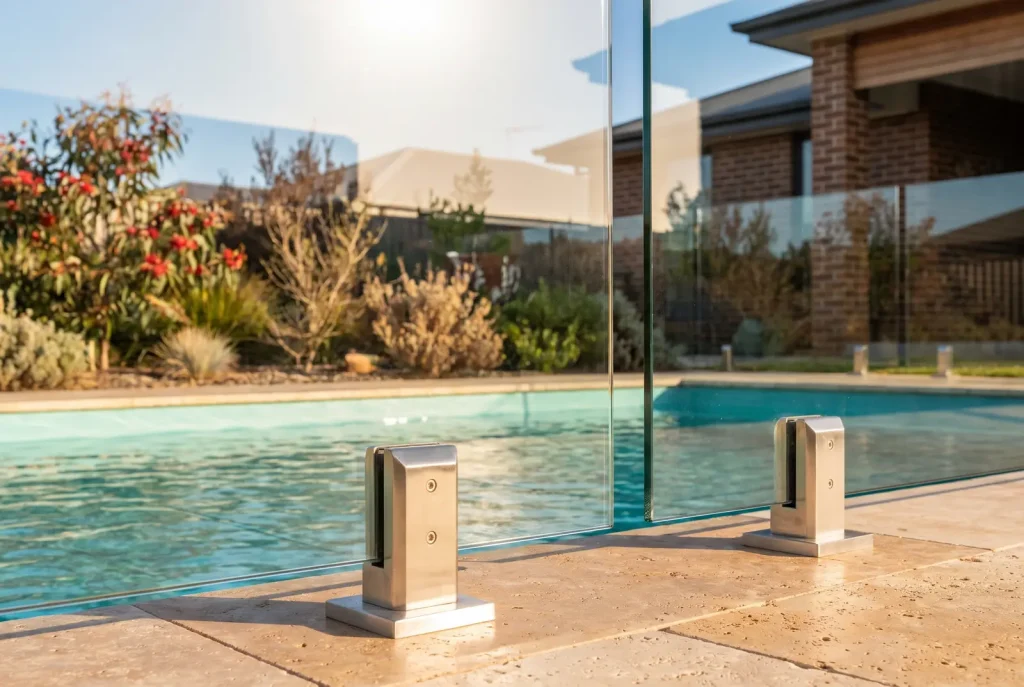
You have chosen semi-frameless glass and settled on a panel thickness, so the hard part is done, right? Not quite. The next decision is one plenty of homeowners overlook until the installer asks about it: the spigots. These are the metal posts that clamp and support each glass panel, and choosing the right style is one of the finer details within a quality glass pool fencing service. Spigot choice is both a structural and an aesthetic decision, so it pays to understand your options before the base fixings go in.
Prefer to watch or listen?
Listen onApple Podcasts
What a Spigot Actually Does
In a semi-frameless system, spigots are the base fixings that carry the entire load of the glass. Each spigot bolts down into concrete or paving, then grips the bottom edge of a glass panel and holds it upright. There are no top rails and no vertical posts between panels, so the spigots do all the heavy lifting.
Because they carry that load, their placement, spacing and fixing quality directly affect how stable the fence feels. Get the base fixing right and a glass fence stands rigid for decades. Get it wrong and panels can flex or work loose. Spigots are also the most visible piece of hardware in the whole run, so their shape and finish shape the overall look just as much as the glass does.
Square Spigots
Square spigots suit crisp, contemporary outdoor areas. Their straight edges and flat faces echo the geometry of modern paving, rendered walls and rectilinear pool shapes, which is why they read as clean and deliberate rather than fussy.
They tend to have a slightly wider mounting footprint at the base, giving a solid, planted appearance. If your alfresco or pool surround already leans into square lines and defined edges, square spigots reinforce that language beautifully.
Round Spigots
Round spigots present a softer visual profile. The curved shape has a slimmer, less imposing presence and blends naturally into garden beds, planting and organic poolside surrounds.
Where a landscape is full of curves, greenery and softer materials, round spigots feel more at home than sharp-cornered hardware. Many homeowners also find them easier to keep clean, since there are no square edges to trap grime.
Mini and Core-Drilled Options
For the most minimalist look, mini spigots and core-drilled or half spigots reduce the amount of visible hardware to a bare minimum. These low-profile fixings sit close to the ground and, in the case of core-drilled versions, set partly into the surface itself.
The result is a fence that mimics a near-frameless appearance while still using a spigot-based system. If your goal is uninterrupted glass with hardware that all but disappears, these are the options to look at. Because they are smaller, spacing and base preparation need to be spot on to keep everything rigid.
How Perth Conditions Influence Spigot Selection
Hardware choice near the coast is not just about looks. Salt-laden air is corrosive, and spigots take the brunt of it because they sit low, catch splash-out and stay in contact with wet surfaces.
Two things matter most in these conditions:
- Finish: Marine-grade stainless steel resists salt corrosion well, while quality powder-coated finishes offer a colour-matched look but rely on the coating staying intact. In beachside Perth suburbs, corrosion resistance should weigh heavily in the decision.
- UV exposure: Constant sun can fade or degrade lesser coatings over time, so durable finishes earn their keep here.
Just as important is the base fixing itself. Spigots must be anchored properly into sound concrete or well-laid paving. A strong spigot bolted into a weak or shallow base is only as good as what it is fixed to, so the substrate deserves real attention.
Matching Spigot Style to Base and Layout
Spigot choice also depends on how and where your fence is mounted. Common scenarios include:
- Freestanding on a paved surround: spigots surface-mount onto concrete or compacted paving.
- Decking mounts: spigots fix through or onto a timber or composite deck, where the substructure matters as much as the visible surface.
- Coping-mounted runs: spigots sit close to the pool edge, so placement and edge distances need careful planning.
Panel layout affects spacing too. Wider panels change how many spigots each run needs and where they land, which in turn influences the visual rhythm of the fence. The style you pick should complement both the base type and the panel arrangement, not fight against them. This is one area where matching hardware to glass matters, and it builds directly on the thinking behind choosing the right glass thickness for your panels.
In the end, spigot choice is one piece of a larger design goal: a barrier that stays safe and compliant while keeping sightlines clean and open. With the hardware sorted, the focus shifts to positioning and layout, where thoughtful framing the outlook beyond the glass turns a functional fence into a feature that makes the most of your Perth surrounds.